AC Maintenance & Servicing
AC Maintenance & Servicing from Reef Al Ghadeer — covering Al Ain and the surrounding districts.

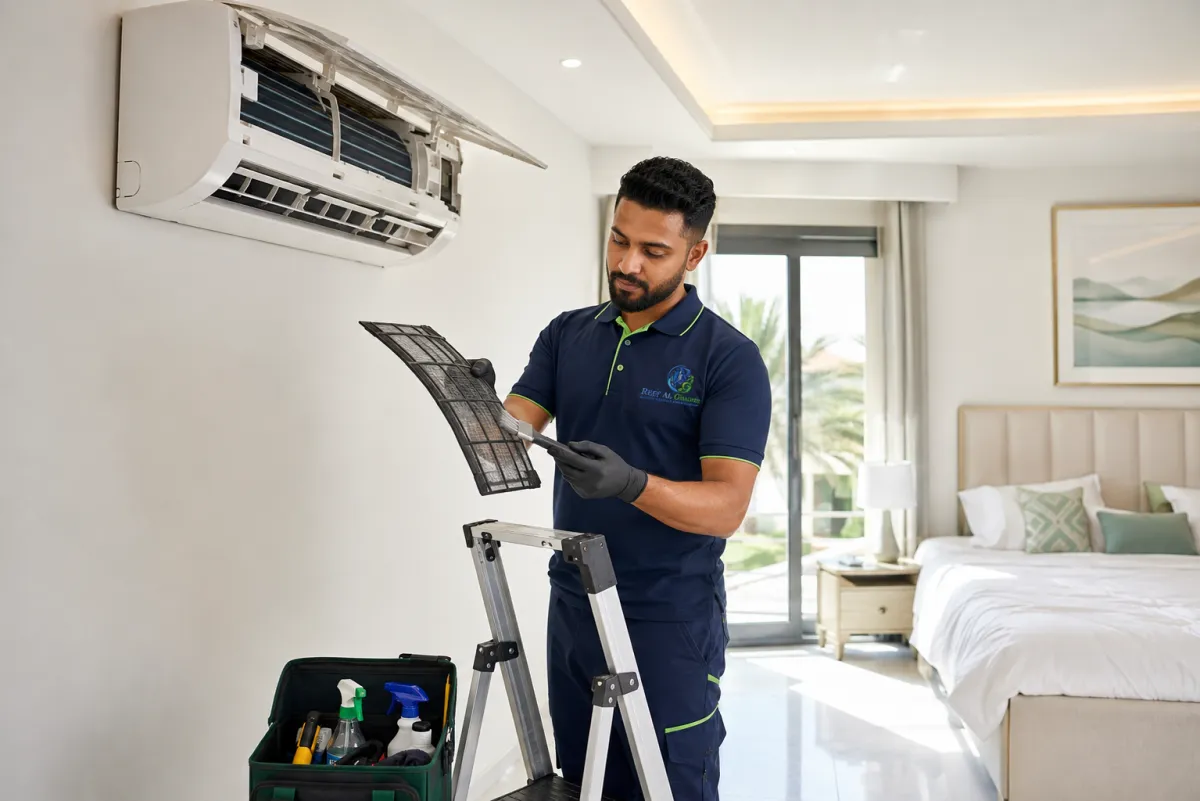
AC not cooling, leaking or not starting? AC repair across Al Ain. Fault diagnosis, honest repair-or-replace advice, written quote before work starts.
If your air conditioning has stopped cooling in the middle of an Al Ain summer, this is not a comfort problem. Inland temperatures here run several degrees above the coast, regularly into the forties, and a property without cooling becomes genuinely difficult within hours.
We repair split units, ducted split systems, package units and FCUs across Al Ain. Call or WhatsApp 00971 56 391 3800 and tell us what it is doing — before you do anything else, there are two checks below that occasionally solve the problem without a callout at all.
We would rather you fixed it yourself in five minutes than paid us to press a button.
Check the breaker and the isolator. If the unit is completely dead, check the circuit breaker at the distribution board and the isolator switch beside the outdoor unit. A tripped breaker after a power cut is common and costs nothing to reset. If it trips again immediately, stop and call us — that is an electrical fault, not a nuisance trip.
Check the filter. If the unit runs but airflow is weak, pull the filter out and look at it. A filter fully blinded with Al Ain dust will choke a system to the point where it appears broken, and can cause the indoor coil to ice over. Wash it, dry it fully, refit it, and give the system an hour.
If neither of those is it, the fault is real. Here is what it is likely to be.
| What you are seeing | Likely causes |
|---|---|
| Running but not cooling | Low refrigerant from a leak; fouled or blocked condenser coil; failed capacitor; compressor not engaging |
| Will not start at all | Tripped breaker; failed capacitor; contactor failure; thermostat fault; control board failure |
| Water dripping indoors | Blocked condensate drain line — the most common call we take. Usually straightforward. Occasionally a cracked drain pan |
| Ice on the pipework or coil | Restricted airflow from a blocked filter or dirty coil, or low refrigerant. Switch off and let it thaw before anyone works on it |
| Outdoor unit running, indoor blowing warm | Refrigerant loss; compressor failure; reversing valve fault on a heat pump |
| Grinding, screeching or rattling | Fan motor bearing; loose blower wheel; failing compressor mounts; debris in the outdoor fan |
| Switching on and off in short bursts | Short cycling — oversized unit, refrigerant issue, thermostat placement, or a failing control |
| Breaker trips whenever AC runs | Electrical fault, compressor drawing excess current, or a wiring problem. Do not keep resetting it |
| Burning or electrical smell | Switch it off at the breaker and call immediately. Do not run it |
The last row is the one to take seriously. An electrical smell from an AC system is not something to monitor for a day or two.
Almost all of our repair volume lands between June and September, and there is a mechanical reason for it beyond simply "it is hot".
An air conditioner rejects heat into the outside air. As ambient temperature climbs, that gets harder, head pressure rises, and the compressor works closer to its limit. Al Ain is inland — the National Center of Meteorology forecasts inland highs of 38 to 44°C against 35 to 41°C on the coast, and Al Ain has hit 48°C on days when coastal areas reached about 41°C.
A system with a partially blocked condenser coil has been coping all winter. In August it has no margin left, and the component that has been quietly degrading — usually a capacitor, sometimes the compressor itself — finally goes. That is why the failure feels sudden and rarely is.
It is also why we push a service visit in March harder than most contractors. A large share of the repairs we attend in July were visible in spring.
Diagnosis first. The technician measures rather than guesses — refrigerant pressures against ambient, compressor current draw, capacitor value, supply and return temperature differential. Parts get replaced because a reading says so, not because swapping something is quicker than diagnosing.
Written quote before work starts. You are told what is wrong, what it costs, and what happens if you leave it. No work proceeds without your agreement.
Leaks get found, not topped up. If the system is low on refrigerant, it is low because it is leaking. Gassing it up without tracing the leak buys a few weeks. We will offer it as a stopgap if you need cooling today, and we will be clear that it is a stopgap.
We tell you when it is not worth repairing. See below.
There is a point where continuing to repair a unit costs more than replacing it, and a repair-only contractor has no incentive to tell you where that point is.
We would lean towards replacement when:
We would lean towards repair when the unit is under about eight years old, the fault is a discrete component such as a capacitor, contactor, fan motor or drain blockage, and the rest of the system tests healthy.
If replacement is the answer we will quote it, and we will also quote the repair so you can see both numbers side by side. See AC installation and replacement.
Compressor replacement, control board replacement and anything needing an ordered part will normally take a second visit. We will tell you at diagnosis which it is rather than leaving you waiting.
We run an emergency maintenance callout for AC failures, 24 hours a day. See emergency callout.
Al Jimi, Al Muwaiji, Hili, Al Mutaredh, Asharej, Zakher, Falaj Hazza, Al Sarooj, Al Towayya, Khatm Al Shiklah, Jebel Hafeet, Sanaiya and Al Ain Industrial Area. Full list on areas we cover.
Call or WhatsApp: 00971 56 391 3800
Email: [email protected]
Book an AC repair
Most often refrigerant loss from a leak, a fouled condenser coil, or a failed capacitor stopping the compressor from engaging while the fan keeps running. Check the outdoor unit — if the fan is turning but you cannot hear the compressor, that points to a capacitor or contactor, which is usually a same-visit fix.
It is almost always a blocked condensate drain line, which is one of the more straightforward repairs. It becomes serious if left, because the overflow will damage ceilings and can reach electrical components. Switch the unit off and call.
The system is drawing more current than the circuit allows — commonly a failing compressor, a shorted capacitor or a wiring fault. Repeatedly resetting the breaker risks damaging the compressor and creates a fire risk. Leave it off and have it looked at.
It depends entirely on the fault. A drain blockage or a capacitor on a twelve-year-old unit is worth repairing. A failed compressor at that age generally is not — the repair cost approaches replacement, and the rest of the system is at a similar point in its life. We will give you both quotes.
Survey first, written quote second, work third. Nothing starts until you agree the scope and the price.